Showing posts with label Armed Forces. Show all posts

Thursday, 1 November 2007

Russian Spetsnaz hand-to-hand combat system - Systema

Systema is a term derived from the original Russian Systema of Hand-to-Hand Combat. More recently, as this style has become exported to western nations, it has become synonymous with Systema or Russian System of Martial Arts.

Systema was developed by the early Cossacks, a highly trained paramilitary society, more than a thousand years ago, and historical record of this fighting style can be dated back to 948 A.D. For Centuries Russia had to repel invaders from the north, south, east and west, each of which brought to bear the peculiar martial skills, physical abilities and weapons of its culture. As a result, the need arose for a fighting style based on adaptability, instinct and ease of learning.

From ancient ages the martial art of Russian warriors deserved worldwide recognition. Even then the Russian close fight inspired fear in the enemies. Ancient Russians were strong in the close fight and won even when all military rules said they could not win. Russian Plastoon Cossacks showed their exclusive art of close fight in the First World War.After the revolution in Russia, emigrating Russian officers brought the Russian martial art to the West. It was the Russian Style that was the basis for training the US sea-soldiers. In Russia the martial art perfected for ages was hidden into secret special schools for training diversionists. The Russian Style is a part of the combat sambo (Russian self-defence without weapon) generated by Spiridono, Kadochnikov. However, the today’s Russian Style standard was created by (who trained at a diversion school) Vadim Starov (who systemised and generalised the knowledge). As a result they created a universal survival system based on the historical battle experience and up-to-date developments in technologies and sciences such as mechanics, physics, medicine, geography, psychology, pathology, etc. Eventually, the System became the life system and world outlook of Slavonic people.

The study and practice of this discipline involves a complete system of physical and spiritual health, relaxation, and courage in the face of all forms of adversity. But most of all, it involves a philosophy of life, peace and decency seldom seen. It disciplines its students to relax while striking, rather than focus to generate maximum power, allowing you to strike at unusual and unexpected angles, to smile in combat rather than adopt a fierce visage or announce your intentions with a blood curdling yell. There are no fixed training patterns or combinations of movements, all training is based on the reality that unexpected things happen in combat.

The purpose of this discipline is not merely to prepare for violence, but to gain a positive and strong mental state, to have a healthier and more limber body, to be more relaxed in a stressful society and to live a decent and peaceful life.

The Russian System of Hand-to-Hand Combat, developed from this need. When the Communists came to power after the October Revolution of 1917, the practice of these fighting skills was prohibited, except by the elite units of the Soviet Special Forces, known as Spetsnaz. These groups had unique training and capabilities for working on the highest risk missions within KGB, and other government agencies. It is only since 1991, with the end of the Communist era, that these martial traditions and styles have become available to the West.

Russia. A new millennium eve. A wild outburst of organised criminals, terrorism, separatism, third powers’ aggression in disguise of mercenaries, hot spot wars. This is the reality of our days. It’s grieving to confess that - in some battles against bandit units - up to ninety percent of Russian soldiers died from wounds made with cold steel. The analysis of the military actions of the Ministry of Internal Affairs and Defence Ministry special teams showed that the close fight role constantly grows in both bandit unit aggression repulse and criminal group suppression. The close fight techniques serve a single aim: saving lives in the extreme conditions of a true Combat.

What is the Russian Style? What is it’s secret hidden in? The secrets of the style should be looked for in regular physics, mechanics, biology, anatomy and psychology manuals rather than in any mystic ciphered treatises. The enemy’s attacks are received softly, in the same plane, by turning the arm or weapon. You should use the enemy’s inertia, add your acceleration, shift his centre of gravity - and the enemy can’t withstand it. By the way -never use your force to oppose the attacking force. Do always feel thedistance. Keeping the contact at the point of touch as a weapon/enemy rotation axis centre allows you to control the enemy by using a system of levers rather than a brute force. Do it easily, spending just a quarter of your physical strength. Having his reserve strength, the close fighter can see and evaluate the whole situation. The close fighter is effective in any age, in any state of health. And - which is important - he can use anything he can reach: a submachine gun, knife, digging tool, even pen or pencil. Moreover, his arms are his weapons too.

Continue reading

Friday, 21 September 2007

Soviet Spetsnaz Tactics

Before spetsnaz units can begin active operations behind the enemy's lines they have to get there. The Soviet high command has the choice of either sending spetsnaz troops behind the enemy's lines before the outbreak of war, or sending them there after war has broken out. In the first case the enemy may discover them, realise that war has already begun and possibly press the buttons to start a nuclear war — pre-empting the Soviet Union. But if spetsnaz troops are sent in after the outbreak of war, it may be too late. The enemy may already have activated its nuclear capability, and then there will be nothing to put out of action in the enemy's rear: the missiles will be on their way to Soviet territory. One potential solution to the dilemma is that the better, smaller part of spetsnaz -the professional athletes — arrives before all-out war starts, taking extreme measures not to be discovered, while the standard units penetrate behind enemy lines after war has started.


In every Soviet embassy there are two secret organisations — the KGB rezidentura and the GRU rezidentura. The embassy and the KGB rezidentura are guarded by officers of the KGB frontier troops, but in cases where the GRU rezidentura has a complement of more than ten officers, it has its own internal spetsnaz guard. Before the outbreak of a war, in some cases several months previously, the number of spetsnaz officers in a Soviet embassy may be substantially increased, to the point where practically all the auxiliary personnel in the embassy, performing the duties of guards, cleaners, radio-operators, cooks and mechanics, will be spetsnaz athletes. With them, as their 'wives', women athletes from spetsnaz may turn up in the embassy. Similar changes of staff may take place in the many other Soviet bodies — the consulate, the commercial representation, the offices of Aeroflot, Intourist, TASS, Novosti and so forth.

The advantages of this arrangement are obvious, but it is not without its dangers. The principal danger lies in the fact that these new terrorist groups are based right in the centre of the country's capital city, uncomfortably close to government offices and surveillance. But within days, possibly within hours, before the outbreak of war they can, with care, make contact with the spetsnaz agent network and start a real war in the very centre of the city, using hiding places already prepared.

Part of their support will come from other spetsnaz groups which have recently arrived in the country in the guise of tourists, teams of sportsmen and various delegations. And at the very last moment large groups of fighting men may suddenly appear out of Aeroflot planes, ships in port, trains and Soviet long-distance road transport ('Sovtransavto'). Simultaneously there may be a secret landing of spetsnaz troops from Soviet submarines and surface vessels, both naval and merchant. (Small fishing vessels make an excellent means of transport for spetsnaz. They naturally spend long periods in the coastal waters of foreign states and do not arouse suspicion, so spetsnaz groups can spend a long time aboard and can easily return home if they do not get an order to make a landing). At the critical moment, on receipt of a signal, they can make a landing on the coast using aqualungs and small boats. Spetsnaz groups arriving by Aeroflot can adopt much the same tactics. In a period of tension, a system of regular watches may be introduced. This means that among the passengers on every plane there will be a group of commandos. Having arrived at their intended airport and not having been given a signal, they can remain aboard the aircraft (An aircraft is considered to be part of the territory of the country to which it belongs, and the pilot's cabin and the interior of the plane are not subject to foreign supervision.) and go back on the next flight. Next day another group will make the trip, and so on. One day the signal will come, and the group will leave the plane and start fighting right in the country's main airport. Their main task is to capture the airport for the benefit of a fresh wave of spetsnaz troops or airborne units (VDV).

It is a well-known fact that the 'liberation' of Czechoslovakia in August 1968 began with the arrival at Prague airport of Soviet military transport planes with VDV troops on board. The airborne troops did not need parachutes; the planes simply landed at the airport. Before the troops disembarked there was a moment when both the aircraft and their passengers were completely defenceless. Was the Soviet high command not taking a risk? No, because the fact is that by the time the planes landed, Prague airport had already been largely paralysed by a group of 'tourists' who had arrived earlier.

Spetsnaz groups may turn up in the territory of an enemy from the territory of neutral states. Before the outbreak of war or during a war spetsnaz groups may penetrate secretly into the territory of neutral states and wait there for an agreed signal or until a previously agreed time. One of the advantages of this is that the enemy does not watch over his frontiers with neutral countries as carefully as he does over his frontiers with Communist countries. The arrival of a spetsnaz group from a neutral state may pass unnoticed both by the enemy and the neutral state.

But what happens if the group is discovered on neutral territory? The answer is simple: the group will go into action in the same way as in enemy territory — avoid being followed, kill any witnesses, use force and cunning to halt any pursuers. They will make every effort to ensure that nobody from the group gets into the hands of their pursuers and not to leave any evidence about to show that the group belongs to the armed forces of the USSR. If the group should be captured by the authorities of the neutral state, Soviet diplomacy has enormous experience and some well-tried counter-moves. It may admit its mistake, make an official apology and offer compensation for any damage caused; it may declare that the group lost its way and thought it was already in enemy territory; or it may accuse the neutral state of having deliberately seized a group of members of the Soviet armed forces on Soviet territory for provocative purposes, and demand explanations, apologies and compensation, accompanied by open threats.

Experience has shown that this last plan is the most reliable. The reader should not dismiss it lightly. Soviet official publications wrote at the beginning of December 1939 that war was being waged against Finland in order to establish a Communist regime there, and a Communist government of 'people's Finland' had already been formed. Thirty years later Soviet marshals were writing that it was not at all like that: the Soviet Union was simply acting in self-defence. The war against Finland, which was waged from the first to the last day on Finnish territory, is now described as 'repelling Finnish aggression' (Marshal K. A. Meretskov, Na Sluzhbe na rodu (In the Service of the People), 1968.) and even as 'fulfilling the plan for protecting our frontiers.' (Marshal A. M. Vasilevsky, Delo Vselgesnle (A Life's Work), 1968.)

The Soviet Union is always innocent: it only repels perfidious aggressors. On other people's territory.

The principal way of delivering the main body of spetsnaz to the enemy's rear after the outbreak of war is to drop them by parachute. In the course of his two years' service every spetsnaz soldier makes thirty-five to forty parachute jumps. Spetsnaz professionals and officers have much greater experience with parachutes; some have thousands of jumps to their credit.

The parachute is not just a weapon and a form of transport. It also acts as a filter which courageous soldiers will pass through, but weak and cowardly men will not. The Soviet Government spends enormous sums on the development of parachute jumping as a sport. This is the main base from which the airborne troops and spetsnaz are built up. On 1 January 1985 the FAI had recorded sixty-three world records in parachute jumping, of which forty-eight are held by Soviet sportsmen (which means the Soviet Army). The Soviet military athlete Yuri Baranov was the first man in the world to exceed 13,000 jumps. Among Soviet women the champion in the number of jumps is Aleksandra Shvachko — she has made 8,200 jumps. The parachute psychosis continues.

In peacetime military transport planes are used for making parachute drops. But this is done largely to prevent the fact of the existence of spetsnaz from spreading. In wartime military transports would be used for dropping spetsnaz groups only in exceptional circumstances. There are two reasons for this. In the first place, the whole fleet of military transport planes would be taken up with transporting the airborne forces (VDV), of which there are an enormous number. Apart from which, military aviation would have other difficult missions to perform, such as the transport of troops within the country from passive, less important sectors to the areas where the main fighting was taking place. Secondly, the majority of military transports are enormous aircraft, built for moving people and equipment on a large scale, which do not suit the purposes of spetsnaz. It needs small planes that do not present large targets and carry no more than twenty or thirty people. They must also be able to fly at very low level without much noise. In some cases even smaller aircraft that take eight to ten, or down to three or four parachutists, are needed.

However, the official term 'civil aviation', which is the source of most spetsnaz transport in wartime, is a substantial misnomer. The minister for civil aviation bears, quite officially, the rank of air chief marshal in the Air Force. His deputies bear the rank of generals. The whole of Aeroflot's flying personnel have the ranks of officers of the reserve. In the event of war Aeroflot simply merges with the Soviet Air Force, and the reserve officers then become regular officers with the same rank.

It has more than enough small aircraft for the business of transporting and supplying spetsnaz units. The best of them are the Yakovlev-42 and the Yakovlev-40, very manoeuvrable, reliable, low-noise planes capable of flying at very low altitudes. They have one very important construction feature — passengers embark and disembark through a hatch at the bottom and rear of the aircraft. If need be, the hatch cover can be removed altogether, giving the parachutists an exit as on a military transport plane, which makes it possible to drop them in complete safety. Another plane that has great possibilities for spetsnaz is the Antonov-72 — an exact copy of the American YC-14 of which the plans were stolen by GRU spies.

But how can spetsnaz parachutists use ordinary civil jet-propelled aircraft, which passengers enter and leave by side doors? The doors cannot be opened in flight. And if they were made to open inwards instead of outwards, it would be exceptionally dangerous for a parachutist to leave the plane, because the force of the current of air would press the man back against the body of the plane. He might be killed either from the force with which he bounced back against the plane, or through interference with the opening of his parachute.

The problem has been solved by a very simple device. The door is arranged to open inwards, and a wide tube made of strong, flexible, synthetic material is allowed to hang out. As he leaves the door the parachutist finds himself in a sort of three-metre long corridor which he slides down so that he comes away from the aircraft when he is slightly to one side and below the fuselage.

Variations on this device were first used on Ilyushin-76 military transport planes. The heavy equipment of the airborne troops was dropped out of the huge rear freight hatch, while at the same time the men were leaving the plane through flexible 'sleeves' at the side. The West has not given this simple but very clever invention its due. Its importance lies not only in the fact that the time taken to drop Soviet parachutists from transport planes has been substantially reduced, with the result that every drop is safer and that forces are much better concentrated on landing. What it also means is that practically any jet-propelled civil aircraft can now be used for dropping parachute troops.

The dropping of a spetsnaz unit can be carried out at any time of the day or night. Every time has its advantages and its problems. Night-time is the spetsnaz soldier's ally, when the appearance of a group of spetsnaz deep in the enemy's rear may not be noticed at all. Even if the enemy were aware of the group's arrival, it is never easy to organise a full-scale search at night, especially if the exact landing place is not known and may be somewhere inaccessible where there are forests and hills or mountains with few roads and no troops on the spot. But at night there are likely to be casualties among the parachutists as they land. The same problems of assembly and orientation which face the pursuit troops face the spetsnaz unit too.

During the day, obviously, there are fewer accidents on landing; but the landing will be seen. Deliberate daytime landings may sometimes be carried out for the simple reason that the enemy does not expect such brazen behaviour at such a time.

In many cases the drop will be carried out early in the morning while there are still stars in the sky and the sun has not risen. This is a very good time if large numbers of soldiers are being dropped who are expected to go straight into battle and carry out their mission by means of a really sudden attack. In that case the high command does its best to ensure that the groups have as much daylight as possible for active operations on the first, most important day of their mission.

But every spetsnaz soldier's favourite time for being dropped is at sunset. The flight is calculated so that the parachutists' drop is carried out in the last minutes before the onset of darkness. The landing then takes place in the twilight when it is still light enough to avoid landing on a church spire or a telegraph pole. In half an hour at the most darkness will conceal the men and they will have the whole night ahead of them to leave the landing area and cover their tracks.

On its own territory spetsnaz has a standard military structure: section, platoon, company, battalion, brigade; or section, platoon, company, regiment. This organisation simplifies the control, administration and battle training of spetsnaz. But this structure cannot be used on enemy territory.

The problem is, firstly, that every spetsnaz operation is individual and unlike any other; a plan is worked out for each operation, which is unlike any other. Each operation consequently requires forces organised, not in a standard fashion, but adapted to the particular plan.

Secondly, when it is on enemy territory, a spetsnaz unit is in direct communication with a major headquarters, at the very least the headquarters of an all-arm or tank army, and orders are received in many cases directly from a high-level HQ. A very long chain of command is simply not needed.

On operations a simple and flexible chain of command is used. The organisational unit on enemy territory is known officially as the reconnaissance group of spetsnaz (RGSN). A group is formed before the beginning of an operation and may contain from two to thirty men. It can operate independently or as part of a detachment (ROSN), which consists of between thirty and 300 or more men. The detachment contains groups of various sizes and for various purposes. The names 'detachment' and 'group' are used deliberately, to emphasise the temporary nature of the units. In the course of an operation groups can leave a detachment and join it again, and each group may in turn break up into several smaller groups or, conversely, come together with others into one big group. Several large groups can join up and form a detachment which can at any moment split up again. The whole process is usually planned before the operation begins. For example: the drop may take place in small groups, perhaps fifteen of them altogether. On the second day of the operation (D+1) eight of the groups will join up into one detachment for a joint raid, while the rest operate independently. On D+2 two groups are taken out of the detachment to form the basis of a new detachment and another six groups link up with the second detachment. On D+5 the first detachment splits up into groups and on D+6 the second group splits up, and so on. Before the beginning of the operation each group is informed where and when to meet up with the other groups and what to do in case the rendezvous is not kept.

Having landed in enemy territory spetsnaz may go straight into battle. Otherwise, it will hide the equipment it no longer needs -boats, parachutes, etc — by either burying them in the ground or sinking them in water. Very often it will then mine the drop area. The mines are laid where the unwanted equipment has been buried. The area is also treated with one of a number of substances which will confuse a dog's sense of smell. After that, the group (of whatever size) will break up into little sub-groups which depart quickly in different directions. A meeting of the sub-groups will take place later at a previously arranged spot or, if this proves problematic, at one of the several alternative places which have been agreed.

The drop area is usually the first place where casualties occur. However good the parachute training is, leg injuries and fractures are a frequent occurrence, and when the drop takes place in an unfamiliar place, in complete darkness, perhaps in fog, over a forest or mountains, they are inevitable. Even built-up areas provide their own hazards. Spetsnaz laws are simple and easy to understand. In a case of serious injury the commander cannot take the wounded man with him; doing so would greatly reduce the group's mobility and might lead to the mission having to be aborted. But the commander cannot, equally, leave the wounded man alone. Consequently a simple and logical decision is taken, to kill the wounded man. Spetsnaz has a very humane means of killing its wounded soldiers -a powerful drug known to the men as 'Blessed Death'. An injection with the drug stops the pain and quickly produces a state of blissful drowsiness. In the event that a commander decides, out of misguided humanity, to take the wounded man with him, and it looks as if this might jeopardise the mission, the deputy commander is under orders to dispatch both the wounded man and the commander. The commander is removed without recourse to drugs. It is recommended that he be seized from behind with a hand over his mouth and a knife blow to his throat. If the deputy does not deal with his commander in this situation, then not just the commander and his deputy, but the entire group may be regarded as traitors, with all the inevitable consequences.

As they leave the area of the drop the groups and sub-groups cover their tracks, using methods that have been well known for centuries: walking through water and over stones, walking in each other's footsteps, and so forth. The groups lay more mines behind them and spread more powder against dogs.

After leaving the drop zone and having made sure that they are not being followed, the commander gives orders for the organisation of a base and a reserve base, safe places concealed from the view of outsiders. Long before a war GRU officers, working abroad in the guise of diplomats, journalists, consuls and other representatives of the USSR, choose places suitable for establishing bases. The majority of GRU officers have been at some time very closely familiar with spetsnaz, or are themselves spetsnaz officers, or have worked in the Intelligence Directorate of a district or group of forces. They know what is needed for a base to be convenient and safe.

Bases can be of all sorts and kinds. The ideal base would be a hiding place beneath ground level, with a drainage system, running water, a supply of food, a radio set to pick up the local news and some simple means of transport. I have already described how spetsnaz agents, recruited locally, can establish the more elaborate bases which are used by the professional groups of athletes carrying out exceptionally important tasks. In the majority of cases the base will be somewhere like a cave, or an abandoned quarry, or an underground passage in a town, or just a secluded place among the undergrowth in a dense forest.

A spetsnaz group can leave at the base all the heavy equipment it does not need immediately. The existence of even the most rudimentary base enables it to operate without having to carry much with it in the way of equipment or supplies. The approaches to the base are always guarded and the access paths mined — the closest with ordinary mines and the more distant ones with warning mines which explode with much noise and a bright flash, alerting any people in the base of approaching danger.

When the group moves off to carry out its task, a few men normally remain behind to guard the base, choosing convenient observation points from which to keep an eye on it. In the event of its being discovered the guard leaves the location quietly and makes for the reserve base, leaving warnings of the danger to the rest of the group in an agreed place. The main group returning from its mission will visit the reserve base first and only then go to the main base. There is a double safeguard here: the group may meet the guards in the reserve base and so avoid falling into a trap; otherwise the group will see the warning signals left by the guards. The craters from exploded mines around the base may also serve as warnings of danger. If the worst comes to the worst, the guards can give warning of danger by radio.

A spetsnaz group may also have a moving base. Then it can operate at night, unhampered by heavy burdens, while the guards cart all the group's heavy equipment along by other routes. Each morning the group meets up with its mobile base. The group replenishes its supplies and then remains behind to rest or to set off on another operation, while the base moves to another place. The most unexpected places can be used by the mobile bases. I once saw a base which looked simply like a pile of grass that had been thrown down in the middle of a field. The soldiers' packs and equipment had been very carefully disguised, and the men guarding the base were a kilometre away, also in a field and camouflaged with grass. All around there were lots of convenient ravines overgrown with young trees and bushes. That was where the KGB and MVD units were looking for the spetsnaz base, and where the helicopters were circling overhead. It did not occur to anybody that a base could be right in the middle of an open field.

In some cases a spetsnaz group may capture a vehicle for transporting its mobile base. It might be an armoured personnel carrier, a truck or an ordinary car. And if a group is engaged in very intensive fighting involving frequent changes of location, then no base is organised. In the event of its being pursued the group can abandon all its heavy equipment, having first removed the safety pin from the remaining mines.

Continue reading >>

From Viktor Suvorov, "Spetsnaz. The Story Behind the Soviet SAS" (Source)

Monday, 2 July 2007

Defense Intelligence Agency - history

After World War II until the creation of DIA, the three Military Departments collected, produced and distributed their intelligence for individual use. This turned out to be too duplicative, costly, and ineffective as each department provided their estimates to the Secretary of Defense or to other governmental agencies.

The Defense Reorganization Act of 1958 wanted to correct these deficiencies by assigning responsibility for Unified and Specified Command intelligence support. However, the intelligence responsibilities remained unclear, the coordination was poor and the first results were short of national reliability and focus. As a result of this poor organization, President Eisenhower appointed the Joint Study Group in 1960 to find better ways for organizing the nation's military intelligence activities.

Acting on the recommendations of the Joint Study Group, Secretary of Defense Robert S. McNamara advised the Joint Chiefs of Staff (JCS) of his decision to establish the Defense Intelligence Agency in February 1961. He assigned them with developing a concept plan that would integrate all the military intelligence of the DoD. The JCS completed this assignment by July, and published DoD Directive 5105.21, "Defense Intelligence Agency" on 1 August, effective 1 October 1961.

DIA reported to the Secretary of Defense through the JCS. It was a union of Defense intelligence and counterintelligence activities, and did not add administrative layering within the Defense intelligence community. The Agency's mission was the continuous task of collecting, processing, evaluating, analyzing, integrating, producing, and disseminating military intelligence for the DoD. Other objectives included more efficiently allocating scarce intelligence resources, more effectively managing all DoD intelligence activities, and eliminating redundancies in facilities, organizations, and tasks.

During the summer of 1961, as Cold War tensions flared over the Berlin Wall, Air Force Lieutenant General Joseph Carroll, soon to become DIA's first director, planned and organized this new agency. It began operations with a handful of employees in borrowed office space on 1 October 1961.

Following DIA's establishment, the Services transferred intelligence functions and resources to it on a time-phased basis to avoid rapidly degrading the overall effectiveness of defense intelligence. Specifically, DoD assigned DIA the mission of collecting, processing, evaluating, analyzing, integrating, producing, and disseminating military intelligence for the Department.

A year after its formation, the Agency faced its first major intelligence test during the superpower confrontation that developed after Soviet missiles were discovered at bases in Cuba.

In late 1962, DIA established the Defense Intelligence School (now the National Defense Intelligence College), and on 1 January 1963, it activated a new Production Center. Several Service elements were merged to form this production facility, which occupied the "A" and "B" Building at Arlington Hall Station, Virginia.

The Agency also added an Automated Data Processing (ADP) Center on 19 February, a Dissemination Center on 31 March, and a Scientific and Technical Intelligence Directorate on 30 April 1963. DIA assumed the staff support functions of the J-2, Joint Staff, on 1 July 1963. Two years later, on 1 July 1965, DIA accepted responsibility for the Defense Attaché System--the last function the Services transferred to DIA.

During these early years of DIA's existence, Agency attempts to establish itself as DoD's central military intelligence organization met with continuing Service opposition. At the same time, the Vietnam War severely tested the fledgling Agency's ability to produce accurate, timely intelligence. In particular, the war increased defense intelligence's involvement in efforts to account for American service members missing or captured in Southeast Asia.

DIA analysts focused during the 1960's on: China's detonation of an atomic bomb and the launching of its cultural revolution; increasing unrest among African nations; and, fighting in Cyprus, and Kashmir; and the missile gap between the US and the Soviets. In the late 1960's, crises that tested intelligence responsiveness included: the Tet offensive in Vietnam; the Six-Day War between Egypt and Israel; continuing troubles in Africa, particularly Nigeria; North Korea's seizure of the USS Pueblo; and the Soviet invasion of Czechoslovakia.

Since 9/11 DIA has been active in nuclear proliferation intelligence collection and analysis with particular interests in North Korea and Iran as well as counter-terrorism. DIA was also involved with the intelligence build-up to the invasion of Iraq in 2003 and was a subject in the Senate Report of Pre-war Intelligence on Iraq. The Defense Intelligence Agency has conflicted with the CIA in collection and analysis on the existence of WMDs in Iraq and has often represented the Pentagon in the CIA-DoD intelligence rivalry due to DIA's alleged clandestine HUMINT collection and often overlapping analysis products. Operational military intelligence has also been a focus, particularly in Iraq with insurgency threats and asymmetric warfare. Further, DIA is responsible for assessing the current and projected national security threats to the United States and presenting these assessments to the Senate Armed Services committee. Finally, DIA still actively maintains its responsibility for conventional strategic and operational military intelligence.

Defense Intelligence Agency - organization

DIA is led by a Director, typically a three-star military officer. The current director is Lieutenant General Michael D. Maples.

DIA is organized into these primary operational directorates:

Directorate for Human Intelligence (DH): Otherwise knows as Defense HUMINT Service, this directorate manages DIA's and the DoD's human source intelligence collection. This includes the Defense Attache System. Defense HUMINT reportedly controls the Strategic Support Branch, a unit that deploys teams of linguists, field analysts, case officers, interrogation experts, technical specialists, and special forces. It is speculated that Defense Secretary Donald Rumsfeld created the SSB to bypass the limitations of the Central Intelligence Agency after 9/11.

Directorate for MASINT and Technical Collection (DT): Collects measurement and signature intelligence which is any intelligence that does not fit within the definitions of Signals Intelligence, Imagery Intelligence, and Human Intelligence. This often includes radar intelligence, acoustic intelligence, nuclear intelligence, and chemical and biological intelligence. DIA is the central intelligence agency for MASINT collection within the intelligence community.

Directorate for Analysis (DI): Analyzes and disseminates finalized intelligence products for the DIA from all sources as well as from partner Intelligence Community agencies. Analysts focus on the military issues that may arise from political or economic events in foreign countries and also analyze foreign military capabilities, transportation systems, weapons of mass destruction (WMDs), and missile systems and contribute to National Intelligence Estimates and to the President's Daily Brief. The Directorate of Analysis also manages the Armed Forces Medical Intelligence Center and the Missile and Space Intelligence Center. Analysts serve DIA in all of the agency's facilities as well as in the field.

Directorate for Intelligence Joint Staff (J2): Advises and supports the Joint Chiefs of Staff with foreign military intelligence for defense policy and war planning.

Defense Joint Intelligence Operations Center (DJIOC): Fuses tactical, operational, and strategic intelligence assets and serves as the center for coordination of these assets in response to combatant command requirements.

DIA also runs the National Defense Intelligence College.

Defense Intelligence Agency - overview

The Defense Intelligence Agency, or DIA, is a major producer and manager of military intelligence for the United States Department of Defense. DIA, designated in 1986 as a Defense Department combat support and intelligence agency, was established in 1961 as a result of a decision by Secretary of Defense Robert S. McNamara, under president John F. Kennedy . The Department of Defense created DIA with the publication of Directive 5105.21, "Defense Intelligence Agency" on 1 August, effective 1 October 1961. DIA was preceded by the Counter Intelligence Corps.

Approximately 8,000 men and women work for DIA worldwide (about 30% are military personnel and about 70% are civilians). The exact numbers and specific budget information are not publicly released due to security considerations. DIA has major operational activities at the Pentagon, the Defense Intelligence Analysis Center (DIAC), Bolling Air Force Base in Washington, D.C., the Armed Forces Medical Intelligence Center (AFMIC) in Fort Detrick, Maryland, and the Missile and Space Intelligence Center (MSIC) in Huntsville, Alabama. DIA is a member of the United States Intelligence Community, reporting to the Director of National Intelligence. The activities of DIA are often compared to Russia's GRU, the UK's Defence Intelligence Staff, and Israel's Aman (IDF).

DIA's mission is to provide timely and objective military intelligence to warfighters, policymakers, and force planners. It is considered to be a member of the Intelligence Community. The director of DIA is the main adviser to the United States Secretary of Defense and the Chairman of the Joint Chiefs of Staff on matters related to military intelligence. Under the support of the Military Intelligence Board, DIA unifies the Defense Intelligence Community on major issues such as the number of deployed forces, assessments, policy, and resources. To help weapon systems planners and the Defense community, DIA plays a major role in providing intelligence on foreign weapon systems.

Organization

History

Joint Functional Component Command for Intelligence, Surveillance and Reconnaissance

Thursday, 28 June 2007

United States Army Intelligence Center

The United States Army Intelligence Center (USAIC) is the US Army's school for professional training of military intelligence personnel. It conducts resident courses for enlisted, warrant officer, and commissioned officer personnel, as well as for international military students in military exchange programs. It has been located at Fort Huachuca, AZ since 1993, when it moved from Fort Devens, MA under the Base Realignment and Closure, although groundbreaking started in 1991.

The Intelligence Center is currently commanded by MG Barbara Fast.

United States Army Intelligence and Security Command

The U.S. Army Intelligence and Security Command (INSCOM), a major Army command, conducts dominant intelligence, security and information operations for military commanders and national decision makers. INSCOM is both an organization within the US Army and the National Security Agency (NSA), the US' unified Signals Intelligence Organization. INSCOM and its counterparts in the Navy and Air Force are known as Central Security Service within NSA.

Charged with providing the warfighter the seamless intelligence needed to understand the battlefield and to focus and leverage combat power, INSCOM collects intelligence information in all intelligence disciplines. INSCOM also conducts a wide range of production activities, ranging from intelligence preparation of the battlefield to situation development, SIGINTanalysis, imagery exploitation, and science and technology intelligence production. INSCOM also has major responsibilities in the areas of counterintelligence and force protection, electronic warfare and information warfare, and support to force modernization and training.

INSCOM is a global command with four brigades that tailor their support to the specific needs of different theaters. Eight other groups or activities located worldwide focus primarily on a single intelligence discipline or function. They are available in a reinforcing role, enabling any combat commander to use INSCOM's full range of unique capabilities.

History

On Jan. 1, 1977, the United States Army Intelligence and Security Command (INSCOM) was organized at Arlington Hall Station, Va. The formation of INSCOM provided the Army with a single instrument to conduct multi-discipline intelligence and security operations and electronic warfare at the level above corps and to produce finished intelligence tailored to the Army’s needs.

The new major command merged divergent intelligence disciplines and traditions in a way that was unique to the Army. Its creation marked the most radical realignment of Army intelligence assets in a generation. Several major building blocks were consolidated to form the U.S. Army Intelligence and Security Command. They were the former U.S. Army Security Agency, a signal intelligence and signal security organization with headquarters at Arlington Hall, Va.; the U.S. Army Intelligence Agency, a counterintelligence and human intelligence agency based at Fort George G. Meade, Md.; and several intelligence production units formerly controlled by the Assistant Chief of Staff for Intelligence and U.S. Army Forces Command.

Brig. Gen. (later Maj. Gen.) William I. Rolya, former commanding general of the Army Security Agency and INSCOM’s first commander, had a wide array of diverse assets at his disposal. Initially, these included eight fixed field stations on four continents inherited from the Army Security Agency, various single-discipline units commanded by the U.S. Army Intelligence Agency, and the production centers in the Washington, D.C., area and at Fort Bragg, N. C.

On Oct. 1, 1977, the former U.S. Army Intelligence Agency headquarters was integrated into INSCOM, and the command established a unified intelligence production element, the Intelligence and Threat Analysis Center, on Jan. 1, 1978. Additionally, INSCOM assumed command of three military intelligence groups located overseas: the 66th Military Intelligence Group in Germany, the 470th Military Intelligence Group in Panama, and the 500th Military Intelligence Group in Japan. These groups were transformed into multidisciplinary units by incorporating former Army Security Agency assets into the previously existing elements. A fourth such group, the 501st Military Intelligence Group, was soon organized in Korea.

Parapsychologic Methods

Under the leadership of General Albert Stubblebine, INSCOM attempted to use parapsychologic methods in order to gather intelligence. This was done as late as 1981. Other intelligence services (such as some German services during World War II) attempted the same before, whithout any useful results.

Army Intelligence (USA)

In the United States Army, approximately 28,000 military personnel and 3,800 civilian personnel are assigned to intelligence duties, comprising the Military Intelligence Corps. The primary mission of Army Intelligence is to provide timely, relevant, accurate, and synchronized intelligence and electronic warfare support to tactical, operational and strategic-level commanders. The Army’s intelligence components produce intelligence both for Army use and for sharing across the national intelligence community.

Structure

  • Office of the Deputy Chief of Staff, Intelligence (G2). As the Army's Chief Intelligence Officer, the responsibilities of the Deputy Chief of Staff for Intelligence include policy formulation, planning, programming, budgeting, management, staff supervision, evaluation, and oversight for intelligence activities, as well as overall coordination of the major intelligence disciplines.
  • The United States Army Intelligence and Security Command, located at Fort Belvoir, Virginia, is the Army's major intelligence command.
  • The United States Army Intelligence Center, located at Fort Huachuca, Arizona, it is the Army's school for professional training of military intelligence personnel.

Wednesday, 27 June 2007

Beta Group or Spetsgruppa B - KGB, Soviet Union.

According to some rumors, Beta Group (also known as Spetsgruppa B) was created within the First Chief Directorate of the KGB with similar duties to those of Alpha Group, although for operations in foreign theatres. Not known if it still exists or was merged with other Spetsnaz units within the KGB, like Vympel.

Some argue that in reality no such group has ever existed. In this belief, once Spetsnaz unit "Vympel" was temporarily renamed to "Vega" (in Russian, "Вега" or just "B") and was subordinated to the MVD. But then, once policy makers realized the idiocy of that move, they re-subordinated "Vega" to the FSB (ex-KGB) and renamed it back to its original historical name "Vympel" (or Department V of CSN FSB RF). So, in other words, there is no such thing as "Beta group".

OSNAZ - [voiska] osobogo naznacheniya.

OSNAZ (Russian: [voiska] osobogo naznacheniya, ОСНАЗ = [войска] особого назначения, "special purpose [detachments]") were special forces troops within the KGB (its predecessors and its successor, Federal Security Service) and the MVD.

OSNAZ has always been shrouded in a veil of mystery and remains so even to this day. There is no OSNAZ headquarters as the various groups were formed within the various directorates as needed.

During the Great Patriotic War the OSNAZ of the NKVD fought on the frontlines against the Nazi Germany as VDV in the form of Airborne regiments/Brigades, with some units achieving "Guards" status at the end of the conflict.

KGB/FSB OSNAZ

The known KGB OSNAZ units were as follows:

It is known that several have survived the fall of the Soviet Government and still exist, with the Alpha Group being the most famous.

MVD OSNAZ

The Ministry for Internal Affairs (MVD) has several OSNAZ units, such as SOBR. Other MVD units such as Vityaz and "Rus" are classed as Spetsnaz units. They act under the aegis of their corresponding GUVD MVD (Main Internal Affairs Directorate of the Interior Ministry). They are not secret or classified units, even if their operations may be classified.

Caveat: OMON is not an OSNAZ unit. Regular police forces (militsiya) also have their special purpose units (OMSN). MVD OSNAZ units and MVD Interior operative troops (such as ODON operatives) usually wear green or olive berets, the most skilled servicemen being awarded with a purple beret (краповый берет, krapovy beret) after succeeding in a tough competition held every year. The latter OSNAZ members are commonly called krapoviki.

SVR OSNAZ

Zaslon is a possible name for a suspected and highly secret OSNAZ organization within the Foreign Intelligence Service (SVR).

Russian Navy

OSNAZ is the name for Russian Navy Special Forces. Formed into 1,000 man brigades, one per Fleet. Each brigade consists of several small battalions.

Organization and structure of Spetsnaz, Russian special purpose regiments.

Federal Security Service units

The Center of Special Operations (CSN) of the FSB is designed to combat terrorism and to protect the constitutional order in the Russian Federation. The CSN FSB consists of 3 different "operative" subdivisions - Department A (also known as spetsgruppa "Alfa"), Department V (also known as spetsgruppa "Vympel"), and so-called SSO (Special Operations Service). The headquarters of CSN FSB is a huge complex of buildings and training areas (dozens of hectares worth of land, 76 training facilities, etc). It is located in the town of Balashikha-2, only 10 km away from the Moscow ring. The average training of a solid CSN operative lasts about 5 years.

"Alfa" is a well-known counter-terrorist unit begun in 1974. Today "Alfa" is a highly professional unit, which consists of roughly 300 servicemen. The majority of the unit is stationed at Moscow, the rest of the unit is located in three other cities - Krasnodar, Yekaterinburg, and Khabarovsk. All the "Alfa" operatives undergo special airborne and firearms training. Roughly one third of them have special mountain training; another third have special counter-sabotage diving training. Spetsnaz operatives always improve on their skills in countless exercises and special operations (including constant service in North Caucasus). The unit utilizes a wide range of modern Russian and foreign weapons and equipment, some modified from the original versions to fit the unique needs of the unit.

"Vympel" (the Pennant) – formerly known as an elite cold war-era KGB sabotage unit – is now also a counter-terrorist and counter-sabotage unit. But, unlike "Alfa", instead of learning how to storm airplanes and buses, they operate in an entirely different environment. They are experts in 18 special disciplines (among which - how to infiltrate guarded buildings, extensive marksmanship training, driving APCs and airplanes, and medical training) and are Russia's last defense against possible terrorist acts involving nuclear plants, hydroelectric dams, and other industrial complexes. However, "Vympel" operatives are still heavily used in special operations missions in the Northern Caucasus, along with their counterparts from "Alfa" unit. "Vympel" has 4 operative units, "Alfa" has 5 operative units. One unit from each Department is always participating in offensive operations in Chechnya. They constantly rotate their troops, and each operative unit is stationed in Chechnya at least 2-3 times per year. "Vympel" is stationed in Moscow, but it also has multiple branch offices in virtually every city where there is a nuclear power plant.

Department A and B operatives' standard BDU color is black. However, in Chechnya they use different kinds of camouflage.

Not much information about SSO can be obtained, but it is known that they also participate in FSB special operations in the Northern Caucasus and also act as highly skilled bodyguards for government officials.

Together with Center of Special Operations and its elite units, there are many FSB special forces units of regional significance. Such operative detachments are usually called ROSN (Regional Department of Special Designation). The most powerful ROSNs are said to be at Saint Petersburg (ROSN "Grad") and Nizhny Novgorod.

Ministry of Interior units

Spetnaz MVD includes 16 Interior Troops units, which are of good quality and intended for use to combat insurgency and for counter-terrorism purposes. These units usually have a unique name and official OSN number. Here is a list of some of these spetsnaz units (the list is deliberately not full due to obvious reasons):

  • 1st PSN (former 6th OSN) VV "Vityaz" - stationed in Moscow;

  • 7th OSN VV "Rosich" - Novocherkassk;

  • 8th OSN VV "Rus" - Moscow;

  • 12th OSN VV "Ratnik" - Nizhni Tagil;

  • 15th OSN VV "Vyatich" - Armavir;

  • 16th OSN VV "Skif" - Rostov.

They are generally well-trained and equipped, being far superior to the regular Russian infantry. For example, it is claimed that the unit "Rus" had fought successfully against the insurgents in Chechnya with a casualty ratio of approximately 1 to 200. Their missions may include reconnaissance missions and regular combat operations (mostly house-to-house CQB assaults). They (especially "Vitjaz") have sometimes served as the back-up team during the counter-terrorist operations by team "Alpha". The parallel of United States Army Rangers and 1st SFOD-D (aka "Delta Force") is apparent.

Aside from the Interior troops special forces, MVD has plenty of police special forces, which are stationed in virtually every large Russian city. While OMON units are mostly used as riot police and during drug busts, they are not really considered a significant counter-terrorist force and simply lack the sufficient expertise. For these reasons MVD has numerous OMSN units (formerly known as SOBR), which consist of senior ranked police officers and are properly trained and equipped to combat terrorists, insurgency, and to participate in any kind of high-risk mission in general.

Russian army special forces

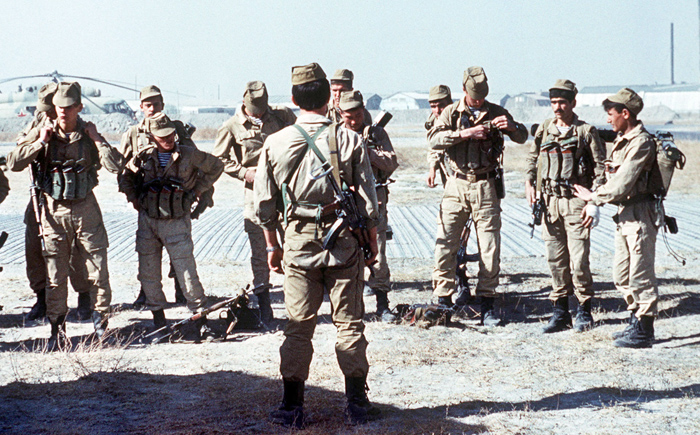
Spetsnaz GRU, or Russian army special forces, are the original SPETSNAZ and are generally considered the best trained units of the Armed Forces of the Russian Federation. Despite this, they are not very similar to the Special Forces of the US or the SAS of the UK. The Spetsnaz have created a fierce reputation as one of the best special forces in the world today due to the very harsh standards of their training. They are controlled by the GRU (the Russian military intelligence agency). During the Cold War, these units were deployed in Eastern Europe in order to carry out reconnaissance and sabotage missions against the NATO forces in the event of a war in Europe. The units of Spetsnaz GRU have no official names, such as is the case with units of Spetsnaz MVD. They are generally referred to by numbers, for example, "16th Separate Brigade of Spetsnaz", much like any other military unit, and are usually integrated in the structure of the VDV (airborne troops) though not under VDV command aegis.

Few details are actually known about the operations of Spetsnaz GRU, but it is known that the units were heavily involved in wars in Afghanistan and Chechnya. Spetnaz GRU teams usually wear standard-issue VDV uniforms, light blue VDV berets and unit patches in order to avoid identification. However, they can also wear different uniforms, for instance, they would wear the uniform of a unit which is stationed nearby, in order to blend in.

Here are most of the Spetsnaz Brigades and the location at which they are stationed:

  • 2nd ObrSpN - Promezhitsy (Pskov region); strength around 960 (Leningrad Military District)

  • 3rd Guards ObrSpN - Roshinskij (Samara Oblast); (Volga-Ural Military District)

  • 10th (Mountain) ObrSpN - Molkino (Krasnodar region); activated July 1, 2003 (North Caucasus Military District)

  • 12th ObrSpN - city of Asbest-5 Sverdlovsk region); (Volga-Ural Military District)transferring: Chaikovskyy (Perm')

  • 22nd Guards ObrSpN - Kovalevka (Rostov Oblast); (North Caucasus Military District)

  • 67th ObrSpN - Berdsk (Novosibirsk Oblast); (Siberian Military District)

  • 83 SPETZNAZ CDO BDE Ussuryysk (Far East Military District)

  • 216 INDEP SPETZNAZ BN Moscow (Moscow Military District)

and many others, including:

  • 14th Separate Brigade of Special Designation Ussuriysk, Far Eastern Military District

  • 16th Spetsnaz Brigade - formerly Teplyi Stan, suburb of Moscow, now [Tambov[Chuchkovo]], Moscow Military District

  • 24th Spetsnaz Brigade - [Ulan-Ude[Kyakhta]], Siberian Military District

A Spetsnaz brigade consists of three to five Spetsnaz battalions, a signals company, support units, and a headquarters company containing highly skilled professional soldiers responsible for carrying out assassinations, kidnappings, and contact with agents in the enemy rear area. The organisation of a naval SPETSNAZ brigade reflects its emphasis on sea infiltration, with up to three frogman battalions, one parachute battalion, and a mini-submarine battalion, as well as the signals company, headquarters company, and support elements.

Russian Naval Spetsnaz

The Soviet Naval Spetsnaz came in to being in 1957 by order of Defence Minister Zhukov.The Black Sea fleet created their spetsnaz unit in 1967. A marine counter terrorist and counter sabotage unit was created in 1969 as "protivodiversionniye sili i sredstva"-counter-underwater forces. In 1970, the Main intelligence service of a General staff (GRU) created a top secret reconnaissance - sabotage group "Delfin" (Dolphin) for operations against sea bases of foreign states. Instructors from group "Delfin" prepared the combat swimmers for KGB groups "Alfa" and "Vympel". At the fall of the Soviet government, each of the Soviet Red Banner Fleets (four total) had a Naval Spetsnaz Brigade assigned to it (see combat swimmers). Furthermore, modern Alfa and Vympel special purpose forces also have naval units.

Russian Naval Infantry, or the Russian Marines, are elite forces, but by no means are they Spetsnaz troops as Naval Special Operations would be carried out by Delfin (Naval Spetsnaz) troops rather than the Marines, which are intended to spearhead amphibious invasions. The 4 Major Naval Spetsnaz units are:

  • 4 INDEP SPETZNAZ PT Parusnoe (Baltyysk) (Baltic Fleet) formerly Viljandi, Estonia (transferred from Army GRU to Navy GRU)

  • 431 INT SPETZNAZ PT Tuapse (Black Sea Fleet) formerly Kronstadt (Baltic Fleet)

  • 42 SPETZNAZ PT Russkyy island (Pacific Fleet)

  • 420 INT SPETZNAZ PT Polyarnyy (Northern Fleet)

Osnaz

Russian intelligence agencies, MVD, FSB, and the FPS and the Foreign Intelligence Service (SVR, "Sluzhba Vneshnej Razvedki", Russian equivalent of the American CIA) have their own Osnaz units.

Overview of Spetsnaz, Russian special purpose regiments.

Russian special purpose regiments or Spetsnaz, Specnaz (Войска специального назначения - спецназ/Voyska spetsialnogo naznacheniya, /spʲeʦnaz/ in IPA) is a general term for "special forces" in Russian, literally "special purpose units". In Russian the term commonly denotes the special forces of all countries and is used by mass media, and civil people to mark all kinds of special purpose units of all kinds of subordination; in English it refers exclusively to the Russian special forces.

In fact, its use in English usually is associated with Russians writing in English or with writers attempting linguistic authenticity. Generally, English-language media refer to them as "Russian special forces".

Spetsnaz can refer to any elite or special purpose units controlled by the Federal Security Service (FSB) with counter-terrorist and anti-sabotage tasks, Ministry of Interior (police) MVD, and the army special forces controlled by the military intelligence service GRU. Nowadays, the term is used as well to describe any special purpose units or task forces of other ministries (even the Emergency Situations Ministry special rescue unit).

Strictly speaking, all Spetsnaz units operated by the KGB/FSB were called OSNAZ, an acronym for [voiska] osobogo naznacheniya or "special purpose [detachments]". These units originally were raised for internal use against right-wing counter-revolutionaries, dissidents, and other undesirables. There has always been a certain amount of shifting of personnel and units between both the GRU who control SPETSNAZ and the MVD with OSNAZ MVD and OSNAZ KGB or FSB, especially between the latter two. Today, OSNAZ is a term mainly used in connection with GRU-controlled COMINT, ELINT and radio-surveillance units within the Armed Forces.

Spetsnaz carry out reconnaissance and social warfare missions in "peacetime" as well as in war. For example, it is known that the assassination of Afghanistan's president carried out by Spetsnaz in December 1979 was under the direction of the KGB.

According to Vladimir Rezun, a GRU defector who used the pseudonym "Viktor Suvorov", there were 20 Spetsnaz brigades plus 41 separate companies. Thus, total strength of Spetsnaz forces in the 1980s could have been around 30,000 troops.

Alpha (alfa) Group was involved in the Beslan school hostage crisis on September 3, 2004. They were criticized for the use of excessive deadly force, which resulted in hostage casualties, including very controversional use of the RPO flamethrowers.

Operations of SMERSH - SMERt' SHpionam (GRU, Soviet Union)

Activity overseas

It was the period between 1933-1943 that saw the original SMERSH's most active overseas operations. During this period, the "Main Enemy" of all Soviet activities was the British Empire. Thus, MI5 and MI6 were the primary opponents of GRU-SMERSH during the period. The methods utilized by MI5 and MI6 and their effectiveness were of particular concern to the GRU and helped increase the paranoia of the Stalinist regime. Thus, few successful SMERSH operations were conducted in the British Empire.

In the United States, as the GRU organized ARMTOG was the sole representative of Soviet power, SMERSH's primary opponent in North America was the Federal Bureau of Investigation. However, while the FBI was effective and surveillencing many communist operations they were as yet unaware of the larger strategic outlines of Soviet operations and thus were often caught off-guard by SMERSH's assassination squads. Thus, many of SMERSH's most successful executions occurred in the United States and Latin America and not Western Europe. They coordinated the assassinations of thousands of suspected Soviet agents that were believed to have turned ranging from Harold Ware in 1935 to Leon Trotsky in 1936 and Juliet Stuart Poyntz in 1937.

The documented cases of suspected SMERSH assassinations outside of the Soviet Union run in the hundreds if not thousands. However, the full extent of the homicides committed by SMERSH overseas will never be known. But given the rather brutal nature of communist party work in covert activities and the highly dangerous world of military human intelligence operations let alone the context of espionage in nations wracked by civil war like China and Spain and Colombia, the numbers are not shocking.

As World War II brought the US, UK, and USSR into alliance, the focus of Soviet counter-intelligence shifted. Thus, during the war the main opponent of SMERSH in its counterintelligence activity was Abwehr, the German military foreign information and counterintelligence department, active during both World War I and World War II.

In all of these operations against foreign intelligence services, SMERSH operated at a more complex and subtle environment and its activities were then part of a larger and more coordinated 'maskirovka' (masked operation) which included the full apparatus of the Soviet organs. Although, SMERSH was utilized as a killing instrument in operations against the Germans, British, and Americans and other powers, it was usually done so as a subordinate agent rather than the principle agent of Soviet activities.

Activity domestically and on the Eastern Front

Since the writ of SMERSH was targeted against traitors, the Soviet Union's national security organs were structured as a counter-intelligence apparatus, and SMERSH primarily originated as a battlefield counter-intelligence group, it was at home in the military ranks that most large scale activities of SMERSH were conducted.

Organized principally to carry out special activities against dissidents within the military including wiping out mutineers, a close look at another vile and brutal Soviet tactic is instructive: the Punishment Battalion. Each military regiment had attached to it a punishment battalion. This military unit's sole role was establish a behind the edge of the battle field area of operation from which all dissidence to the Soviet Union was eliminated. This area was the province of anti-partisan, anti-sabeteur, anti-espionage activities on the battlefield by GRU.

Additionally, the punishment battalions other activities in securing this area was establishing a killing zone in which even Soviet troops were killed if they fled the battlefield. Used only in extraordinary circumstances, the punishment battalions would begin forcing Soviet soldiers forward to ensure they didn't break upon assaults on the enemy or flee from a defensive position when assaulted. Investigating potential mutineers or those who refused to properly implement orders and then carrying out their executions in this area was the final role of SMERSH.

As Soviet armies began their advance upon occupied German territory, it was foreseen that a substantial period of insurgency against Soviet arms would begin. Most of the Ukrainian and a substantial portion of the Belorussian population was opposed to the Soviet Union. Large armies had in fact been recruited by the Germans to aid in their war against the Soviets at the front and in the rear against the Red Partisans. To secure the supply lines, effect military order, and establish Soviet power it was viewed necessary to utterly smash any opposition or dissidence to Soviet rule. Therefore, it was concluded that SMERSH needed to be reinforced with substantial new assets including legal standing within the Soviet power structure. It was these new requirement which caused the previously shadowy SMERSH to come out from clandestine operations under military service commands to strategic authority under Stalin's direct command.

SMERSH activities also included "filtering" the soldiers recovered from captivity. It was also used extensively to "filter" the population of the gained territories, including Eastern Europe. The SMERSH was directly involved in the collection, interrogation, and execution of tens of thousands of Polish military officers, clerics, and political leaders at the Katyn Forest Massacre. The SMERSH was also actively involved in the capture, of tens if not hundreds of thousands of suspected disloyalists, anti-Soviets, and White Partisans in the Soviet Union such as forced repatriation, and execution of Soviet citizens who had been active in anti-communist armed groups fighting on the side of Nazi Germany such as the Russian Liberation Army, the Cossack Corps of Pyotr Krasnov, and the Organization of Ukrainian Nationalists. This also included eastern POWs and eastern workers. Finally, SMERSH handled the capture and interrogations and executions of hundreds of thousands of German and Japanese POWs as well as the capture of thousands of American, British, French and Chinese soldiers, sailors, airmen, and expatriates many of whom were later murdered or died in captivity.

SMERSH was also used to punish those within the NKVD itself; it was allowed to investigate whomever it wished in the NKVD structure; department and directorate heads were not immune from it. Smersh would also often be sent out to find and kill defectors, double agents, etc.

SMERSH was also used by INO (the NKVD's later KGB FCD, First Chief Directorate, responsible for foreign intelligence operations outside of the USSR) to hunt down "enemies of the people" outside of Soviet territory.

As the war concluded, SMERSH was given the assignment of finding Adolf Hitler and, if possible, capturing him alive or recovering his body. Red Army officers and SMERSH agents found Hitler's partially burned corpse near the Führerbunker after his suicide and conducted an investigation to confirm the events of his death and identify the remains which (along with those of Eva Braun) were reportedly secretly buried at SMERSH headquarters in Magdeburg until April 1970, when they were exhumed, completely cremated, and dumped in a river.

Overview of SMERSH - SMERt' SHpionam (GRU, Soviet Union)

SMERSH (short for SMERt' SHpionam (СМЕРть Шпионам), or "Death to Spies") was the name of a specialized counterintelligence department in the Main Intelligence Directorate of the General Staff GRU of the Soviet Union. Operating under various names since the beginning of the GRU, it was given its most notorious name SMERSH during the years immediately preceding World War II. The direction of SMERSH was to secure the rear of the active Red Army from partisans, saboteurs, and spies, on the front to investigate and arrest conspirators and mutineers, "traitors, deserters, spies, and criminal elements", and support the General Staff's strategic operations by carrying out global assassination of elements considered subversive to the military stability of the Red Army.

History

Soviet intelligence policy generally divided their activities along three directions in accordance with the division of power in the Soviet Union: State, Party, Military. The State's primary intelligence arm was the Cheka and remained focused on counter-intelligence; the Party's main intelligence arm was the various Communist Commissions on the domestic front which focused on political counter-intelligence and the Communist International which was focused on foreign intelligence and covert operations; and the Military which focused on politico-military activities both intelligence and counter-intelligence at home and abroad. Because of the early status of the Soviet Union as a pariah nation, most of what today would be considered politico-military intelligence activities as conducted by a state power were conducted by the GRU.

SMERSH existed within the GRU almost from its beginning. However, the early years were almost entirely devoted to investigating and carrying out counter-intelligence operations against partisans, saboteurs, and other dissident elements at home in the military units or in areas of rebellion of the Soviet Union. Therefore, as the Russian Civil War died down and Moscow's grip became more strengthened, the elements which it constituted were almost entirely folded up and replaced by the Checka and various paramilitary police organizations such as the MVD.

However, the GRU remained as the primary covert intelligence service of the Soviet Government following its almost total isolation by world powers. The GRU became the primary agent of the Soviet Union in obtaining military-industrial hardware such as electronics, aerospace design, radio communications, etc., as well as traditional military intelligence such as unit strength, table of organization values, military policy and strategy, etc.

As the various global powers came to grip with the spread of GRU activities, counter-intelligence activities by the Western nations soon began blocking penetration attempts, then later identifying potential GRU agents, and finally expanding more complex counter-intelligence operations of doubling and disinforming GRU agents. At this point in the late 1920s, the ruthlessness of the Soviets which had featured the summary executions of millions of dissidents at home let alone suspected spies were now brought to bear on GRU officers and their agents who were suspected of wittingly or unwittingly working for the Western powers. Thus, the various death squads of the Russian Civil War were reactivated for use in the GRU. For the next twenty years, operating under various names, usually under names such as killing squads, death to traitors, death to spies etc, were named, but always operating under the same bureau of the Defense Chief Counter-intelligence Directorate.

As the requirements of war expanded and the Soviet arms began their conquest of previously occupied German territory, the complexities of counter-espionage, counter-insurgency, and occupation were sufficiently large to encourage the Stalin to consolidate all of SMERSH under his direct control. On April 15, 1943 SMERSH was officially transferred to NKO (Narodnyi Komissariat Oboroni). The full name of the head entity was Главное управление контрразведки СМЕРШ Народного комиссариата обороны СССР, or USSR People's Commissariat of Defense Chief Counterintelligence Directorate "SMERSH". At the same time SMERSH directorate within the People's Commissariat of the Soviet Navy and SMERSH department of NKVD were created.. All were to be coordinated by a single directorate with its own analytical division. It was headed by Viktor Abakumov, who instead of reporting to the Defense Committee now reported directly to Stalin.

As the war wound down, the need for a strategic directorate focused on counter-espionage wet operations and counter-insurgency pacification operations which answered directly to Stalin was no longer viewed necessary. Thus, on March 1946 SMERSH Chief Directorate was resubordinated to the People's Commissariat of Military Forces (Наркомат Вооруженных Сил, НКВС. Additionally, as a period of increased scrutiny by Western powers was expected as well as a new Soviet propaganda offensive at political subversion of Western anti-communist resistance, the Soviets further sought to purge the image of SMERSH and the HKBC was latter reorganized into the Ministry of Military Forces (МВС) soon thereafter), and officially discontinued in May, 1946. However, the elements and organs of SMERSH remained structured and glimpses of the organization remained as late as the 1950s, particularly during the Korean War and the late 50's Cold War.

Some high-profile assassinations or disappearances of individuals that would historically have been under the writ of SMERSH also continued. These include Louis Adamic, Noel Field and his entire family, and hundreds of Field's agents. Additionally, numerous suspected GRU German agents as well as a number of Allied agents (even intelligence officers) disappeared in Berlin and other parts of occupied Europe well into the 1950s.

SMERSH had functioned as an organization to mobilize youth in national defense, and some of its promising young members, such as Yuri Modin, were recruited into the KGB.

Organization

SMERSH was divided into 8 sections:

  1. Counter-intelligence protection of central Red Army institutions

  2. Work among POWs

  3. Counterespionage and conduct radio games

  4. Organization of Counter-intelligence behind front lines

  5. Oversight of SMERSH organs in military districts

  6. Investigations

  7. Information and statistic

  8. Codes and communications

Operations of GRU, the Main Intelligence Directorate of Soviet Union and Russian Federation.

According to the Federation of American Scientists: "...Though sometimes compared to the US Defense Intelligence Agency, the GRU's activities encompass those performed by nearly all joint US military intelligence agencies as well as other national US organizations. The GRU gathers human intelligence through military attaches and foreign agents. It also maintains significant signals intelligence and imagery reconnaissance and satellite imagery capabilities." GRU Space Intelligence Directorate had put more than 130 SIGINT satellites into orbit. GRU and KGB SIGINT network employed about 350,000 specialists.

According to GRU defector Stanislav Lunev, "Though most Americans do not realize it, America is penetrated by Russian military intelligence to the extent that arms caches lie in wait for use by Russian special forces". He also described a possibility that compact tactical nuclear weapons known as "suitcase bombs" are hidden in the US and noted that "the most sensitive activity of the GRU is gathering intelligence on American leaders, and there is only one purpose for this intelligence: targeting information for spetsnaz (special forces) assassination squads [in the event of war]". The American leaders will be easily assassinated using the "suitcase bombs", according to Lunev. GRU is "one of the primary instructors of terrorists worldwide" according to Lunev Terrorist Shamil Basayev reportedly worked for this organization.

During the 2006 Georgian-Russian espionage controversy several officers (allegedly working for GRU) were accused by the Georgian authorities of preparations to commit sabotage and terrorist acts. GRU detachments from Chechnya were transferred to Lebanon independently of the United Nations Interim Force in Lebanon after the 2006 Israel-Lebanon conflict "to improve Russia’s image in the Arab world", according to Sergei Ivanov. Zelimkhan Yandarbiyev was assassinated by two GRU officers. GRU officers have also been accused of creating criminal death squads.

Miscellaneous

Chechnya

Dmitry Kozak and Vladislav Surkov from the current Putin administration reportedly served in GRU. Two Chechen former warlords Said-Magomed Kakiev and Sulim Yamadayev are commanders of "West" and "East" battalions that are controlled by GRU (each battalion includes close to a thousand fighters).

Baranov

In 2002, Bill Powell wrote Treason, an account of the experiences of former GRU colonel Vyacheslav Baranov. Baranov had been recruited by the CIA and agreed to spy for them, but was betrayed to the Russians by a mole in either the FBI or the CIA and spent five years in prison before being released. The identity of the mole remains unknown to this day, although speculation has mounted that it could have been Robert Hanssen.

Overview of GRU, the Main Intelligence Directorate of Soviet Union and Russian Federation.

GRU is the English transliteration of the Russian acronym ГРУ, which stands for "Главное Разведывательное Управление" (Glavnoje Razvedyvatel'noje Upravlenije), meaning Main Intelligence Directorate. The full name is GRU GSh (GRU Generalnovo Shtaba (or "GenShtaba"), i.e. "GRU of the General Staff").

The GRU is Russia's largest intelligence agency. It deploys six times as many agents in foreign countries as the SVR which is the KGB intelligence successor. It also commanded 25,000 spetsnaz troops in 1997.

The current GRU Director is General Valentin Vladimirovich Korabelnikov.

History

The GRU was created in 1918 by Lenin, and given the task of handling all military intelligence. It operated residencies all over the world, along with the SIGINT (signals intelligence) station, in Lourdes, Cuba (22.995° N 82.464° W), and throughout the former Soviet bloc countries, especially in Lithuania, Latvia, and Estonia.

The GRU was well-known in the Soviet government for its fierce independence from rival power blocs, even the CPSU and KGB. At the time of the GRU's creation, Lenin infuriated the Cheka (predecessor of the KGB) by ordering it not to interfere with the GRU's operations. Nonetheless, the Cheka infiltrated the GRU in 1919. This planted the seed for a fierce rivalry between the two agencies, which were both engaged in espionage, and was even more intense than the rivalry between the FBI and CIA in America at that time.

The existence of the GRU was not publicized during the Soviet era. It became widely known in Russia, and the West outside the narrow confines of the intelligence community, during perestroika, in part thanks to the writings of "Viktor Suvorov" (Vladimir Rezun), a GRU agent who defected to Britain in 1978, and wrote about his experiences in the Soviet military and intelligence services. According to Suvorov, even the General Secretary of the Communist Party of the Soviet Union couldn't enter GRU headquarters without going through a security screening.

The GRU is still a very important part of the Russian Federation's intelligence services, especially since it was never split up like the KGB was. The KGB was dissolved after aiding a failed coup in 1991 against the then Soviet leader Mikhail Gorbachev. It has since been divided into the SVR (Foreign Intelligence Service) and the FSB (Federal Security Service).

USSR Border Troops - Pogranichnyie Voiska SSSR.

Soviet Border Troops, (Russian: Пограничные войска СССР, Pogranichnyie Voiska SSSR) were the militarized border guard of the Soviet Union, subordinated to its subsequently reorganized state security agency: first to Cheka, then to NKVD and, finally, to KGB. Accordingly, they were known as NKVD Border Troops and KGB Border Troops (with Russian abbreviations - НКВД СССР/- КГБ СССР added on the end of official names). Unlike border guards of many other countries, Soviet Border Troops were a centralized force including also the maritime borderguarding units (i.e., a coast guard).

History

In 1934, under the NKVD, Border Troops were immediately subordinated to the GUPVO (abbreviated "Chief Directorate of Border and Internal Guard"). In 1939 they were reorganized into the GUPV ("Chief Directorate of Border Troops").

NKVD Border Troops consisted of infantry, cavalry, reconnaissance, naval and airforce units.
Since the 1930s, the distinctive part of Soviet Border Troops uniform is the intensively medium-green colored parts of headwear and insignia. The color is also present on a maritime Border Troops ensign.

World War II

Border Troops units on the western USSR frontier saw particularly fierce combat in the first weeks of the German invasion of the USSR (June-July 1941). They bore the brunt of the initial German assault, and due to this, suffered high casualty rates. Border Troop sevicemen were among the defenders of the legendary Brest Fortress. Border troops from other parts of the Soviet border were also involved in the fighting of the war. Notably, the 105th, 157th, and 333rd Border Troops regiments (operating like regular army units) took part in the Battle for Berlin in 1945.

A distinct problem in the first days of the war were German Brandenburger Regiment commandos. They had obtained NKVD Border Troops uniforms and led many infiltration missions across the Red Army lines to inflict subversion.

Post-War history

After the formation of the KGB, Soviet Border Troops became subordinated to this agency and remained so until the end of Soviet rule. As such, the Troops were concentrating on the tasks of preventing Soviet citizens from escaping to the West and fighting espionage infiltrations. The former task created a number of anecdotes about Soviet-Jewish illegal emigrants that attempt to cross the border and trick the Border Troops patrol.

A dense and sophisticated system of field engineering devices was created to keep Soviet border intact (including its complicated terrain and harsh climate zones). The most notable in that system was the trace-control strip (Russian: контрольно-следовая полоса) - a primitive labour-demanding method making surface crossing virtually impossible. The mission also required significant manpower and intensive maritime presence.

The Border Troops consisted of conscripts drafted by the same system as for the Soviet Army, and small number of professional enlistees. Officers were trained in specialized academies (particularly, in the city of Khmelnytskyi, Ukrainian SSR). Both conscripts and officer candidates for Border Troops were carefully selected and checked by the KGB. This made service in the troops privileged.

Famous people linked to Soviet Border Troops

Alexander Lukashenko, the President of modern Belarus served as an officer, whilst Mikhail Saakashvili, the President of modern Georgia, and Viktor Yuschenko, the President of modern Ukraine, served their conscript service in the Soviet Border Troops. Konstantin Chernenko, the second last Soviet leader (CPSU Secretary General) also served as a border guard on the USSR-Chinese border, before becoming more involved in politics.

Dissolution and legacy

With the fall of Soviet Union, Border Troops formations in most Soviet republics became border guards of the respective independent states. These new guards mostly changed their name and subordination. However, they retained some Soviet traditions, most notably the green-colored uniform and "Border Guard's Day" (Russian: День пограничника), an official holiday celebrated both by active service and former border guards.

The new states of Armenia and Tajikistan are unique exceptions. Tajikistan's border with Afghanistan has been guarded by the Russian Border Guard (suffering heavy fighting) until the late 1990s under a special treaty. Armenia's border is still guarded by Russians under similar conditions.

Katyn massacre - mass execution of Polish citizens ordered by Soviet authorities in 1940.

The Katyn massacre, also known as the Katyn Forest massacre (Polish: zbrodnia katyńska, literally 'Katyń crime'), was a mass execution of Polish citizens ordered by Soviet authorities in 1940. Estimates of the number of executed persons ranges from 15,000 to 21,768. Polish POWs and prisoners were murdered in Katyn forest, Kalinin (Tver) and Kharkiv prisons and elsewhere. About 8,000 of the victims were officers taken prisoner during the 1939 invasion of Poland, the rest being Polish citizens who had been arrested for allegedly being "intelligence agents, gendarmes, spies, saboteurs, landowners, factory owners and officials." Since Poland's conscription system required every unexempted university graduate to become a reserve officer, the Soviets were thus able to round up much of the Polish intelligentsia, as well as the Jewish, Ukrainian, Georgian and Belarusian intelligentsia of Polish citizenship.

The term "Katyn massacre" originally referred to the massacre, at Katyn Forest near villages of Katyn and Gnezdovo (about 12 miles (19 km) west of Smolensk, Russia), of Polish military officers confined at the Kozelsk prisoner-of-war camp. It is applied now also to the execution of prisoners of war held at Starobelsk and Ostashkov camps, and political prisoners in West Belarus and West Ukraine, shot on Stalin's orders at Katyn Forest, at the NKVD (Narodny Komissariat Vnutrennikh Del) Smolensk headquarters and at a slaughterhouse in the same city, as well as at prisons in Kalinin (Tver), Kharkiv, Moscow, and other Soviet cities.

The 1943 discovery of mass graves at Katyn Forest by Germany, after its armed forces had occupied the site in 1941, precipitated a rupture of diplomatic relations between the Soviet Union and the Polish government-in-exile in London. The Soviet Union continued to deny responsibility for the massacres until 1990, when it acknowledged that the NKVD secret police had in fact committed the massacres and the subsequent cover-up. The Russian government has admitted Soviet responsibility for the massacres, although it does not classify them as war crimes or as acts of genocide, as this would have necessitated the prosecution of surviving perpetrators, which is what the Polish government has requested. It also does not classify the dead as the victims of Stalinist repressions, in effect barring their formal posthumous rehabilitation.

What are you interested in?

Digg this!